
Written by Nancy Taneja
Counselling Psychologist · EFT Therapist · Founder, HeartSpace
How to Use This Journal
This booklet borrows from Cognitive Behavioural Therapy (CBT) — the idea that our feelings and choices are shaped less by what actually happens, and more by what we believe about what happens. A situationship doesn’t just hurt because of what the other person does or doesn’t do. It hurts because of the stories we start telling ourselves to make sense of the ambiguity.
There are no right answers here — only honest ones. Take your time with each question. Write in pen, in pencil, in fragments if that’s all that comes. The goal isn’t to finish the journal. It’s to catch your own thinking in the act, gently enough that you can choose differently.
This journal has four parts:
Part One — What Is Actually Keeping Me Here?
Part Two — Catching the Automatic Thought (a CBT thought record)
Part Three — Common Thinking Traps in Situationships
Part Four — Questioning the Belief, Rewriting the Story & What I Need Going Forward
PART ONE
What Is Actually Keeping Me Here?
Before we question the thought, we need to find it. Most of us stay in unrewarding relationships not because we’re unaware something is wrong, but because some part of the arrangement is quietly paying off. Let’s find out what that payoff is — without judgement.
1. What do I actually get from this relationship, in the moments it feels good?
2. What am I afraid will happen if I leave?
Be specific. Afraid of being alone? Afraid no one else will want me? Afraid I’ll regret it?
3. What would it mean about me if this ended?
“If this relationship ends, it means I am ___.
4. Whose voice does that belief sound like?
A parent’s? An ex’s? Society’s? Your own younger self’s?
5. What does staying protect me from feeling, even
temporarily?
6. If a close friend described this exact relationship to me, what would I tell her to do?
7. What is the gap between what I’m telling myself and what I’d tell her?
That gap is usually where the distorted thinking is hiding
PART TWO
Catching the Automatic Thought
In CBT, an automatic thought is the fast, often unquestioned belief that fires the moment something happens — before you’ve had a chance to examine it. Pick one recent moment in this relationship that left you anxious, hurt, or confused, and walk it through the steps below
The situation — what actually happened (just the facts):
The automatic thought — what went through your mind in
that moment:
The emotion it brought up, and its intensity (0–100):
Evidence that supports this thought:
Evidence that does not support this thought:
PART THREE
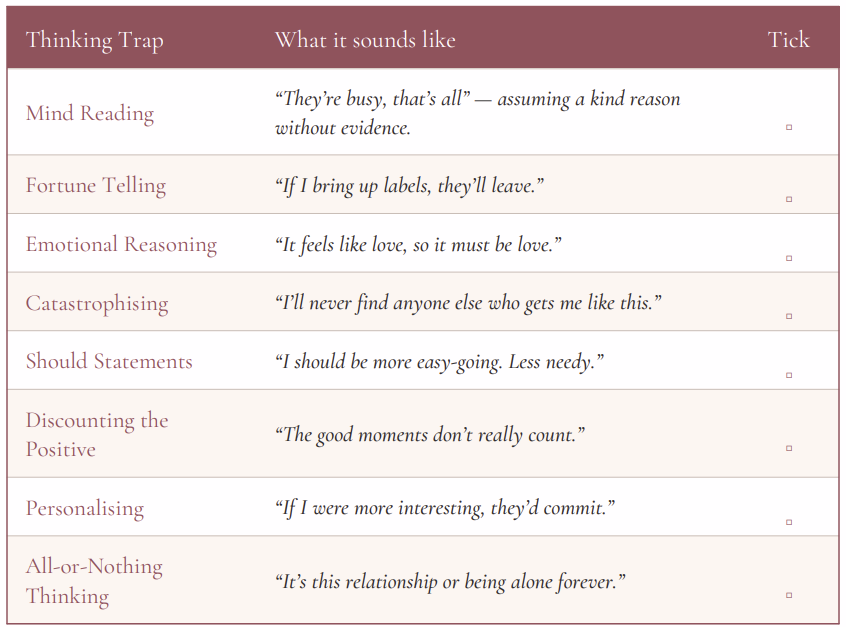
Common Thinking Traps in Situationships
Tick any that sound familiar. Recognising the pattern is often the moment its grip starts to loosen.
Thinking Trap
What it sounds like
Tick
Mind Reading
“They’re busy, that’s all” — assuming a kind reasonwithout evidence.
Fortune Telling
“If I bring up labels, they’ll leave.”
Emotional Reasoning
“It feels like love, so it must be love.”
Catastrophising
“I’ll never find anyone else who gets me like this.”
Should Statements
“I should be more easy-going. Less needy.”
Discounting the
Positive
“The good moments don’t really count.”
Personalising
“If I were more interesting, they’d commit.”
All-or-Nothing
Thinking
“It’s this relationship or being alone forever.”
Which one shows up for me the most, and where else in my
life have I seen it?
PART FOUR
Questioning the Belief & Rewriting the Story
This is the heart of CBT: not arguing yourself out of a feeling, but gently interrogating the thought beneath it until it loosens its grip on its own. Use the automatic thought from Part Two, and put it through these questions.
1. Is this thought 100% true? What’s the evidence, really?
2. Am I confusing a feeling (“it feels like love”) with a fact (“it is love”)?
3. Is there another way to explain this situation?
4. What would I say to a friend who told me this exact thought?
5. Am I judging myself by a standard I wouldn’t apply to anyone else?
7. Five years from now, will this thought still feel true?
A QUESTION WORTH SITTING WITH
“Is this thought true — or is it just familiar?”
PART FOUR · CONTINUED
Rewriting the Story & What I Need Going
Forward
A balanced thought isn’t a falsely positive one — it’s simply one that holds all the evidence, not just the frightened part of it.
My old automatic thought:
A more balanced thought, that still tells the truth:
Try: “Even though I’m afraid of ___, the evidence shows ___, so a more balanced thought is ___.”
What would change in how I act this week, if I believed this balanced thought instead?
What I Need Going Forward
If I’m honest, here’s what I actually need from a
relationship to feel safe in it:
One small, values-aligned action I can take this week — for myself, not for them:
A sentence I want to remember, the next time the old
thought shows up:
A CLOSING NOTE
Your Thoughts Are Not Facts
Every belief that has kept you here once made sense — it kept you safe, or
hopeful, or connected to something you needed. Questioning it isn’t a betrayal
of that need. It’s how you finally meet it somewhere that can hold it properly.
Walk away whole. The right relationship will never ask you to leave yourself
behind in order to stay in it.
With warmth,
Nancy Taneja
Counselling Psychologist & EFT Therapist, Founder of HeartSpace
WANT SUPPORT WORKING THROUGH THIS, ONE TO ONE?